
Marie Vandenberghe
CEO, Quality Training
Honored as “The Founder Setting New Standards in 2026”
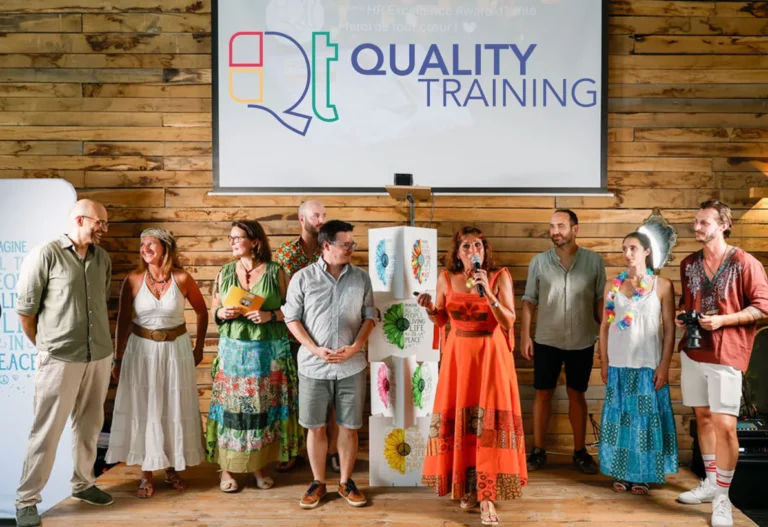
The Founder Setting New Standards In 2026
Marie Vandenberghe’s journey is a story of growth shaped by people, learning, and the courage to evolve. As CEO of Quality Training, she has built her career around a simple but powerful belief: learning creates its greatest value when it leads to meaningful change. What began in 2008 as a focus on training delivery gradually developed into a broader leadership journey involving entrepreneurship, team building, strategy, client relationships, and business growth.
Her transition from trainer to entrepreneur and eventually CEO was not originally part of a fixed plan. Yet, each stage brought lessons that strengthened the next. The skills developed in training, particularly listening, adapting communication, understanding people, and creating engagement, became equally important in leadership. Over time, Vandenberghe came to see these experiences not as separate chapters, but as connected parts of one purpose: helping people grow while creating environments where organizations can grow with them.
From Trainer To Entrepreneur
When Vandenberghe founded Quality Training, her primary focus was close to the learning experience itself. She valued the direct interaction with participants and the satisfaction of seeing people develop new skills. As the organization expanded, however, leadership required her to move beyond delivery and embrace responsibilities that demanded a different perspective.
Building teams, delegating responsibilities, shaping strategy, managing client relationships, and making business decisions became essential parts of her role. The transition brought a new understanding of what effective learning means in a business environment.
Her experience as a trainer remained central to this evolution. Listening carefully and adapting to different personalities helped her understand that business success is closely connected to the ability to understand people. It also changed her approach to training. Rather than treating learning as a standardized service, she increasingly viewed it as a practical response to specific organizational needs.
This philosophy continues to influence Quality Training. The company’s approach places importance on understanding the client’s reality before creating a learning solution. For Vandenberghe, customization is not simply a commercial advantage. It is a reflection of respect for the people taking part in the learning process.
Leadership Built On Human Values
Vandenberghe’s leadership philosophy is grounded in respect, humanity, agility, curiosity, and responsibility. These values influence how Quality Training works with clients, trainers, partners, and its wider professional community.
Her approach recognizes that consistency in values does not require identical methods. International business has exposed Quality Training to different cultures, communication styles, organizational structures, and expectations. Rather than applying a single formula, Vandenberghe believes leaders must understand context and adapt accordingly.
“Being consistent in your values does not mean being rigid in your methods,” she explains.
This principle has become particularly relevant as Quality Training works across different environments. Listening before designing, understanding local expectations, and building trust are treated as important parts of successful learning.
For Vandenberghe, leadership is therefore not only about setting direction. It is also about creating the conditions in which people can contribute, develop, and feel understood. That perspective has helped connect the company’s business objectives with a broader commitment to people development.
Learning That Responds To Real Business Needs
A key part of Vandenberghe’s approach is the belief that training should not exist separately from the workplace. Learning becomes valuable when it helps people address genuine challenges and apply new capabilities in their everyday roles.
This belief has encouraged Quality Training to look beyond standard training models. Instead of assuming that the same program will work for every organization, the company focuses on understanding the needs of both the organization and its participants.
Such an approach also reflects the changing expectations of modern professionals. Employees increasingly want learning that is practical, relevant, and connected to their careers. Organizations, meanwhile, expect training to contribute to performance, adaptability, and long-term capability.
Vandenberghe’s journey has reinforced the importance of this connection. Her experience as both trainer and business leader gives her a perspective that combines the human side of learning with the strategic needs of organizations.
Preparing For The AI Era
Artificial intelligence is now reshaping the learning and development sector, and Vandenberghe sees the transformation as much broader than the introduction of new technology.
AI is changing how professionals search for information, create content, analyze data, communicate, and learn. It is also changing expectations around workplace skills. Quality Training is responding by incorporating subjects such as Microsoft Copilot, generative AI, and prompting into its training portfolio.
Yet technology is only one part of the equation.
The organization also emphasizes critical thinking, verification, confidentiality, ethics, and responsible use. This reflects Vandenberghe’s view that technological capability must be balanced with sound human judgment.
“The more powerful technology becomes, the more valuable human capabilities become,” she says.
Communication, empathy, creativity, emotional intelligence, adaptability, and ethical decision-making are becoming increasingly important because professionals must know how to use technology responsibly and effectively.
This shift also points toward a future in which learning is less confined to formal training sessions. As digital tools become embedded in everyday work, learning itself can become a continuous process that happens alongside professional activity.
Navigating Change And Building Resilience
For Vandenberghe, one of the biggest challenges facing professionals is not a lack of expertise, but an unwillingness to adapt. A person can become highly skilled in one area while the surrounding business environment changes rapidly.
Technical knowledge remains important, but it must be supported by curiosity and the willingness to learn, unlearn, and relearn. This mindset is becoming increasingly important as technology changes the nature of many roles.
Another area Vandenberghe highlights is human connection. In a workplace increasingly influenced by digital tools and AI, the ability to communicate clearly, collaborate, build trust, manage emotions, and understand different perspectives can become a major professional asset.
She also points to the importance of asking thoughtful questions. AI can produce answers quickly, but professionals still need to determine what should be asked, whether an answer is reliable, what may be missing, and how the information should be applied.
This creates a new definition of professional capability. Success increasingly depends on combining technical fluency with judgment and human understanding.
Recognition Through Meaningful Impact
Professional recognition has also taken a broader meaning in Vandenberghe’s career. Awards and industry acknowledgment are welcomed, but she views them primarily as recognition of a collective effort rather than individual achievement.
The progress of Quality Training has involved trainers, employees, collaborators, clients, and partners. Each has contributed to the organization’s development.
For Vandenberghe, some of the most meaningful forms of recognition are not necessarily formal. They can be found in long-term client relationships, positive changes experienced by participants, and trainers who take pride in being part of the professional community.
The company’s ability to contribute to humanitarian initiatives also adds another dimension to its purpose. Business growth, in this view, can create opportunities to support causes beyond commercial objectives.
The guiding question remains straightforward: “Are we creating something meaningful? Are people better because of what we do?”
Setting New Standards For 2026 And Beyond
As Quality Training moves forward, Vandenberghe’s vision is shaped by the same principles that have guided her career: people, adaptability, meaningful learning, and responsible innovation.
The future of professional development is likely to demand a closer relationship between technology and human capability. Organizations will need people who can work confidently with AI while maintaining critical thinking, ethical judgment, creativity, and empathy.
Vandenberghe’s own career reflects that balance. Her evolution from trainer to entrepreneur and CEO demonstrates how experiences that initially appear unrelated can ultimately form a coherent leadership path.
Quality Training’s next chapter is therefore not simply about responding to technological change. It is about helping professionals and organizations understand how to work through that change without losing sight of the human qualities that make learning meaningful.
In 2026, Vandenberghe continues to build on that philosophy, setting standards not only through business growth, but through a model of leadership that connects knowledge with action, technology with judgment, and organizational progress with human development.